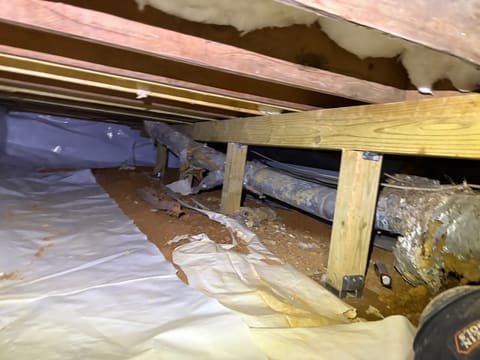
Atlanta's pre-1980 homes — the bungalows of Grant Park, the Craftsman houses of Inman Park, the older stock across Decatur, Virginia-Highland, and Druid Hills — share a problem you can't see from the curb. They were built with open, vented crawl spaces over red clay, before anyone understood how moisture behaves in a humid Southern climate. Decades of ground dampness with nowhere to go is why so many of them have rot, mold, and sloping floors today.
We love working on these houses. They're built better than most of what goes up now — but the one place they're consistently behind is under the floor. Here's why, and what can actually be done about it without touching the character that makes an old Atlanta home worth owning.
How Atlanta built crawl spaces before 1980
For most of the last century, the standard crawl space was a dirt floor with foundation vents cut into the perimeter walls. The thinking was simple: let outside air move through and it'll carry moisture away. Builders installed those vents as a matter of course, with little or no vapor barrier over the ground. (U.S. Dept. of Energy — on the shift away from vented crawl spaces)
On paper it made sense. In Atlanta's climate, it backfires.
Why old vented crawl spaces fail in our climate
The flaw is the humidity. For much of the year, the outdoor air we're inviting in through those vents is more humid than the air already under the house. So instead of drying the space out, the vents pull warm, wet air across the cool surfaces of your framing and ductwork, where it condenses — the same way a glass of iced tea sweats on a summer porch.
Modern building science has measured what happens next: sealing a crawl space instead of venting it cuts crawl space humidity by more than 20% and reduces heating and cooling load. (U.S. Dept. of Energy — Moisture Control) An open vented crawl space over our red clay does the reverse: it keeps a steady supply of moisture against wood that was never meant to stay damp.
Now add time. A house built in 1925 has had a hundred years of that cycle. That's why the problems compound in older homes — it's not that they were built poorly, it's that they've been quietly humid for generations.
What we find under historic homes, by era and neighborhood
Different pockets of Atlanta were built in different eras, and the crawl spaces tell on them:
- Grant Park, Kirkwood, and Cabbagetown bungalows (1900s–1930s). Shallow crawl spaces, original-growth framing that's strong but long exposed to damp, and almost never a vapor barrier. We see rotted band joists and sagging floors near the foundation walls.
- Inman Park Craftsman and Victorian homes (1890s–1920s). Some of the oldest stock in the city, often with multiple additions over the decades, which means mismatched foundations and drainage that was never planned as a whole.
- Druid Hills and Virginia-Highland (1910s–1930s). Larger homes on rolling, wooded lots — beautiful, but the slopes funnel water toward the house, so the crawl spaces here flood as much as any in the city.
- Decatur and Avondale Estates (1920s–1950s). A mix of bungalow and early-ranch stock; vented crawl spaces over heavy clay, frequently with decades-old insulation that's sagged into the dirt and gone to mold.
The common thread is always the same: ground moisture, open vents, and time.
Can you modernize a historic crawl space without hurting the house?
Yes — and this is the part owners of old homes worry about most. Crawl space work is non-structural and entirely below the living space. Nothing about it changes the visible house, the trim, the windows, or anything a historic district cares about. It happens under the floor, out of sight.
The modern fix follows the same order on a 1920s bungalow as on a new build, just with more care for tired framing:
- Handle the water first — correct grading and downspouts, add interior drainage and a sump if the space takes on water.
- Repair what a century of damp has done — rebuild rotted joists, band joist, and supports. On older homes this is where we spend the most time, because the framing is worth saving. Sagging or bouncy floors usually trace right back here (more on that on our sagging floor repair page).
- Seal and encapsulate — a vapor barrier across the ground and up the walls, sealed vents, and humidity control, so the space finally stops feeding moisture into a house that's stood for a hundred years.
We stabilize and reinforce from below; we don't underpin footings or push piers. What an old Atlanta home almost always needs is the water handled and the framing saved — and that's exactly what we're built for.
Where to start
If you own one of these homes, the move is the same whether it's a 1910 Craftsman or a 1950s Decatur ranch: get under there and find out what a century of moisture has actually done. We'll document what we find, lay out the repairs in order, and put it in writing — see our encapsulation cost page for how pricing works, or just book a free crawl space inspection and we'll tell you straight where your house stands.