Sagging Floor Repair
Why Are My Floors Sagging or Bouncy — and What Does It Cost to Fix?
A floor that dips toward the center of a room or bounces when you walk across it is almost always a problem under the house, not in the floor itself. Over a crawl space, it usually means the supports holding your floor up are failing — settled columns, an undersized or rotted girder, or joists softened by years of moisture. The fix is structural support that carries the load and re-levels the floor, and it runs about $185 per linear foot, with most jobs landing between $2,000 and $4,000. Here's what's actually happening down there.
The honest version
Why is my floor sagging or bouncy?
Your floor is held up from below by joists resting on girders (beams), which are carried by posts or columns down to the crawl space ground. When the floor starts to sag or bounce, one of those supports has stopped doing its job. The usual culprits, in roughly the order we find them:
| Cause | What's happening under the house |
|---|---|
| Failing or settled support columns | The posts holding up the girder have sunk into the soil or were never adequate, so the beam — and the floor on it — drops. |
| Moisture-rotted joists or girder | A damp crawl space softens the wood over years until it can't carry the load. This is the most common cause we see in Atlanta. |
| Undersized or over-spanned framing | Older homes were sometimes built with supports too far apart for the span, so the floor flexes — that's the bounce. |
| A missing or shifted girder | A beam that's rotated, cracked, or was removed in a past "renovation" leaves the joists with nothing solid under them. |
The bounce is the early warning; the visible sag and the doors that won't latch come later. Catching it at the bouncy stage is the cheaper repair.
How sagging floors get fixed
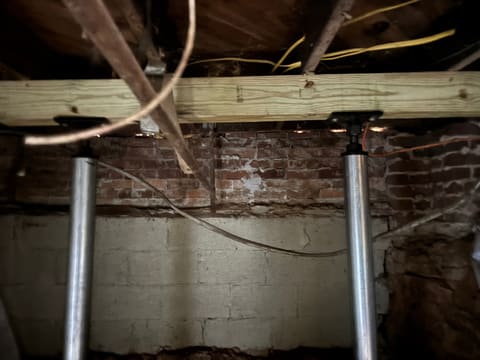
The repair rebuilds the support path from the ground up. We set new footings in the crawl space and install drop girders with adjustable steel columns that carry the load properly — and let us gradually bring the floor back toward level instead of just stopping the sag where it is. Where moisture has rotted the joists, the band joist, or the subfloor, we rebuild that framing as part of the job, because bracing rotted wood just delays the next failure.
The part a lot of crews skip: the moisture that caused the rot is still there when they leave. If your floor sagged because the crawl space stays wet, re-leveling without drying the space out just starts the clock over. That's why we look at the whole picture — the support and the water — and tell you honestly if controlling the moisture needs to be part of the fix.
What does sagging floor repair cost in Atlanta?
Structural floor support runs about $185 per linear foot, and most sagging-floor jobs land between $2,000 and $4,000 depending on how much of the floor needs support and how much rotted framing has to be rebuilt. A single bounced span is at the low end; a whole-room sag with rotted joists is at the high end.
We don't run a calculator on this page on purpose — a real number comes from going under the house and seeing what's actually failing. The free inspection is where we find the cause, measure the support you need, and put the scope and price in writing before you commit, with interest-free financing on bigger jobs and a 2-year warranty on the repair. Because this is structural work that overlaps with foundation repair, you can see the full breakdown on our Atlanta foundation repair cost page.
Why crawl space floors sag in Atlanta
It comes back to moisture and red clay. Our clay soil holds water against the crawl space and stays damp for days after a storm, and the long humid stretch from May through September keeps the air under the house wet. Wood that lives in that environment for years softens, and softened joists and girders sag under a load they used to carry fine. Add the settling that expansive clay causes under the support columns, and you have two forces working your floor loose at once.
It shows up most in the older neighborhoods — Decatur, Kirkwood, East Atlanta, Marietta — where homes went up decades ago over open, vented crawl spaces with whatever moisture control was standard at the time, which often was none.
Why you fix the moisture, not just the floor
This is where the cheap fix and the lasting one part ways. A crew can jack the floor back up and call it done, and it'll feel solid the day they leave. But if the crawl space that rotted the wood is still wet, the new framing starts down the same road and the sag comes back — now with money already spent on a repair that didn't address why it happened.
The honest version is that a sagging floor over a wet crawl space is two problems wearing one symptom. We fix the support so the floor is solid and level, and we tell you straight whether the crawl space needs encapsulation to keep the moisture from rotting it again. Sometimes it does, sometimes it doesn't — but you should hear it either way before you pay for the structural work alone.
How It Works
Four steps. No confusing jargon.
We keep the process simple and transparent so you know exactly what to expect before anyone starts work.
-
Inspection
We evaluate the crawlspace or basement and document what we find with photos and moisture readings.
-
Assessment
We review moisture levels, drainage, and structural integrity to understand the full picture.
-
Clear Plan
You receive a practical proposal tailored to your property. No jargon, no pressure, no surprises.
-
Repair
Our team performs the work and walks you through the result so you see exactly what was done and why.
Homeowner Proof
What Atlanta homeowners say.
Extremely happy and grateful for the service I received. They came out the same day I called for an estimate and provided it right away. I loved the entire experience, and would definitely recommend them and use them again.
Frequently Asked
Common questions
Why is my floor bouncy or sagging in the middle of the room?
How much does it cost to fix a sagging floor in Atlanta?
Can a sagging floor be made level again?
Is a bouncy floor dangerous?
Do I need to fix my crawl space moisture too?
Do you offer financing for structural floor repair?
Don’t Wait Until It’s Major
Get a clear plan for the space below your home.
Schedule a crawlspace or basement evaluation and understand what needs attention — no pressure, no obligation.
Free & No Obligation
Schedule Your Inspection
Tell us what’s happening under the house. We’ll follow up within one business day.