Sump Pump Installation
How Much Does Sump Pump Installation Cost in Atlanta?
A standalone sump pump installation in metro Atlanta starts around $1,500. If your basement or crawl space is taking on water, the real fix is usually a sump tied into an interior drainage system, and that starts at about $3,000. The gap between those two numbers is the difference between dropping a pump in a pit and building the system that actually keeps the water out. Below is what moves the number, and how to know which one you need.
The honest version
What does sump pump installation cost in Atlanta?
There are really two jobs people call "a sump pump," and they're priced differently because they're different work. Dropping in a pump where there's already a working pit is the smaller one. Building the drainage that feeds the pump — so the water actually has somewhere to go — is the bigger one. Here's the honest breakdown:
| The job | What it usually involves | Where it starts |
|---|---|---|
| Standalone pump install or replacement | A new pump set in an existing basin, wired, with a check valve and a proper discharge line | from $1,500 |
| Interior drainage system with sump | A perimeter drain channel that collects water and routes it to a new sump basin and pump | from $3,000 |
| Battery backup | A second pump and battery so you're covered when the power goes out mid-storm | added to the above |
We don't run a calculator on this page, and that's on purpose. A number a website spits out before anyone has seen your basement isn't a quote — it's a guess. The table above is the honest version of the same math. We measure the run, check the water, and put the real total in writing at the free inspection.
What affects the cost of a sump pump installation?
Two homes can both "need a sump pump" and land at very different numbers. Here's what actually moves it:
| Factor | Why it moves the price |
|---|---|
| Pump only vs. full drainage | A replacement in an existing pit is the small job. Cutting in a perimeter drain to feed a new sump is the bigger one. |
| Basement or crawl space | A sump in a tight, low crawl space is slower, more miserable work than a stand-up basement. |
| Digging the basin in red clay | Atlanta clay is dense and slow to dig. A new pit takes more labor than setting a pump in one that's already there. |
| Discharge run | The water has to exit far enough from the foundation that it doesn't just circle back. A long or buried discharge line adds material and labor. |
| Battery backup | Storms knock out power exactly when you need the pump most. A backup is a second pump and a battery — worth it, but it adds cost. |
| Pump size and quality | A cast-iron pump with the right horsepower for your water volume outlasts a builder-grade plastic one, and costs more up front. |
| Existing water damage | If standing water has already rotted wood or grown mold, that gets handled as part of a fix that lasts. |
When you need a full drainage system, not just a pump
A sump pump is a drain, not a dam. It empties a pit — it doesn't stop water from coming through your walls or up through the floor. If water is actively getting in during storms, a pump dropped into a hole will run constantly and still leave you with a wet basement, because nothing is collecting the water and routing it to the pit in the first place.
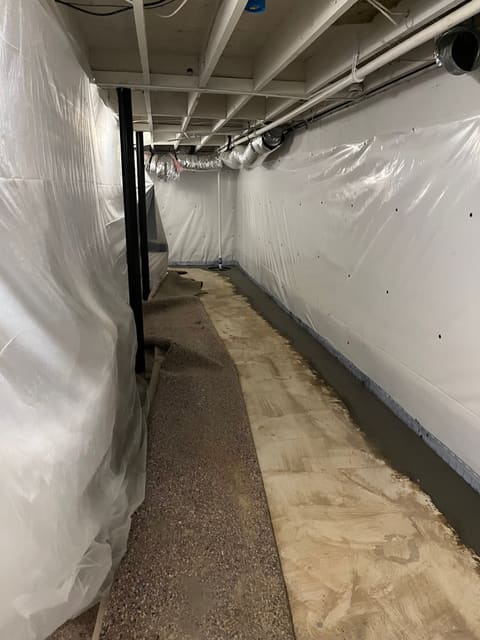
That's what an interior drainage system does: a channel around the perimeter catches the water where it enters and carries it to the sump, which sends it out and away. For a crawl space, the same logic applies — the sump only earns its keep when there's drainage feeding it. When someone quotes you "just a pump" for a basement that floods, ask where the water is supposed to go on its way to the pit. The honest answer is usually a drainage system.
Why sump pumps matter so much in Atlanta
Our red clay soil doesn't drain — it holds water against the foundation and stays saturated for days after a storm. That standing pressure is exactly what drives water up through a basement floor or into a crawl space. Stack our heavy spring and summer downpours on top of clay that won't shed water, and a working sump isn't a luxury here, it's the thing standing between a storm and a flooded basement.
It's also why a backup matters more in Atlanta than the national articles assume. The hardest rains are the ones most likely to flicker the power — and a sump that's off during the one storm that mattered is the same as no sump at all.
Why a cheap sump pump install fails
The cheapest install is a builder-grade pump dropped in the pit, discharged a few feet from the wall, with no backup and no drainage feeding it. It works until the first real test. Then the discharge water circles right back to the foundation, or the power blips during the storm, or the undersized pump can't keep up — and you're bailing out a basement you paid to protect.
A real install sizes the pump to your water, runs the discharge far enough out that it stays out, adds a backup for the storms that knock out power, and — when water is actually getting in — feeds the pit with drainage instead of hoping the pump does it all. You pay once for the system that holds, and every install carries a 2-year warranty. If it's part of a bigger waterproofing job, we offer interest-free financing.
How It Works
Four steps. No confusing jargon.
We keep the process simple and transparent so you know exactly what to expect before anyone starts work.
-
Inspection
We evaluate the crawlspace or basement and document what we find with photos and moisture readings.
-
Assessment
We review moisture levels, drainage, and structural integrity to understand the full picture.
-
Clear Plan
You receive a practical proposal tailored to your property. No jargon, no pressure, no surprises.
-
Repair
Our team performs the work and walks you through the result so you see exactly what was done and why.
Homeowner Proof
What Atlanta homeowners say.
Extremely happy and grateful for the service I received. They came out the same day I called for an estimate and provided it right away. I loved the entire experience, and would definitely recommend them and use them again.
Frequently Asked
Common questions
How much does it cost to install a sump pump in Atlanta?
Do I need a sump pump or a full drainage system?
Can a sump pump go in a crawl space, not just a basement?
Do I need a battery backup for my sump pump?
How long does a sump pump last?
Do you offer financing for waterproofing work?
Don’t Wait Until It’s Major
Get a clear plan for the space below your home.
Schedule a crawlspace or basement evaluation and understand what needs attention — no pressure, no obligation.
Free & No Obligation
Schedule Your Inspection
Tell us what’s happening under the house. We’ll follow up within one business day.