Vapor Barrier Installation
What Does Crawl Space Vapor Barrier Installation Cost in Atlanta?
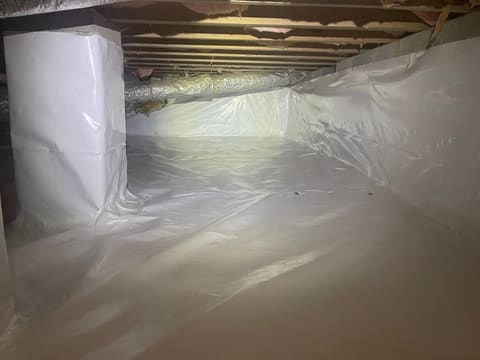
A real crawl space vapor barrier installation isn't a roll of plastic laid on the dirt — it's a sealed system across the floor and up the walls, and it's the foundation of any encapsulation. We price it as part of the full encapsulation rate of $5 to $7 per square foot, because the barrier only does its job when it's installed as part of the whole. Below is what a proper install actually involves, and why the DIY version almost always fails.
The honest version
What does vapor barrier installation cost?
We don't price a vapor barrier as a standalone roll of plastic, because installing it that way doesn't solve anything. A reinforced barrier, sealed at every seam and run up the walls, is the core layer of crawl space encapsulation — so it's priced as part of that system at $5 to $7 per square foot, with your total driven mostly by the size of your crawl space.
That rate covers the install done right: a heavy, reinforced barrier across the entire floor, sealed seams, the barrier carried up the foundation walls and around the piers, and the penetrations closed. The math is simple — a 1,200-square-foot crawl space at $6 per square foot is about $7,200 for the encapsulation the barrier anchors. We don't run a calculator on this page on purpose; a number a website spits out before anyone's seen your crawl space isn't a quote. We measure your actual square footage at the free inspection and put the real total in writing, and we offer interest-free financing on bigger jobs.
What a real vapor barrier installation involves
The difference between a vapor barrier that works for fifteen years and one that fails in one is entirely in the install. Here's what a proper one includes:
| Step | Why it matters |
|---|---|
| Clear and prep the ground | Debris and old, torn plastic come out first so the new barrier lies flat and tight. |
| Heavy reinforced barrier | A thick, reinforced liner stands up to crawling traffic and time — not the thin sheeting from the home store. |
| Sealed and overlapped seams | Seams are overlapped and sealed so moisture can't wick up between sheets. Unsealed seams are where most barriers fail. |
| Run up the walls | The barrier carries up the foundation walls and is fastened, so vapor can't bypass it at the perimeter. |
| Sealed around piers and penetrations | Every pier, post, and pipe gets sealed to — the gaps are exactly where moisture sneaks back in. |
Done this way, the barrier cuts off the ground moisture that drives crawl space humidity, rot, and mold. Done as a loose tarp, it just hides the dirt.
Why DIY vapor barrier installation usually fails
This is the most common thing we get called out to redo. A homeowner — or a cheap crew — lays thin plastic over the crawl space floor, doesn't seal the seams, doesn't run it up the walls, and calls it encapsulated. It looks finished for a year. Then the seams separate, moisture wicks up through the gaps, and the wood above starts holding humidity it shouldn't.
The bigger crews aren't immune either. We see plenty of jobs where a national outfit installed a barrier but left the walls bare or skipped sealing around the piers — the gaps that quietly let the moisture right back in. By the time the musty smell or the buckling floor shows up, you're paying to pull out the failed plastic and fix the damage that grew underneath it, on top of doing the install correctly the second time. Doing it right once is almost always cheaper than the redo.
Why it matters more in Atlanta
Our red clay holds water and pushes ground moisture up for days after a storm, and the long humid stretch from May through September keeps an open crawl space damp far longer than drier climates. A vapor barrier is the layer that cuts that ground moisture off at the source. Skip it or install it loose, and you've left the single biggest moisture driver under your house untouched — which is why the install quality matters more here than the national how-to articles let on.
Vapor barrier vs. full encapsulation — what's the difference?
People use the terms loosely, so here's the honest line between them. The vapor barrier is the sealed liner across the floor and up the walls — it's the foundation of the system. Full encapsulation is the barrier plus the rest of what keeps a crawl space dry for good: sealed vents, a dehumidifier sized to the space, and drainage or a sump if there's standing water.
For a dry crawl space with a ground-moisture problem, a properly sealed barrier may be most of what you need. For a space that's actually taking on water or running high humidity, the barrier alone won't hold the line — you need the full system. We'll tell you which one your crawl space actually calls for at the inspection, and either way it carries our 2-year warranty. You can see the full breakdown on our crawl space encapsulation cost page.
How It Works
Four steps. No confusing jargon.
We keep the process simple and transparent so you know exactly what to expect before anyone starts work.
-
Inspection
We evaluate the crawlspace or basement and document what we find with photos and moisture readings.
-
Assessment
We review moisture levels, drainage, and structural integrity to understand the full picture.
-
Clear Plan
You receive a practical proposal tailored to your property. No jargon, no pressure, no surprises.
-
Repair
Our team performs the work and walks you through the result so you see exactly what was done and why.
Homeowner Proof
What Atlanta homeowners say.
Extremely happy and grateful for the service I received. They came out the same day I called for an estimate and provided it right away. I loved the entire experience, and would definitely recommend them and use them again.
Frequently Asked
Common questions
How much does crawl space vapor barrier installation cost in Atlanta?
Why isn't a vapor barrier priced separately from encapsulation?
Can I install a crawl space vapor barrier myself?
What thickness of vapor barrier do you use?
Is a vapor barrier the same as full encapsulation?
Do you offer financing for crawl space work?
Don’t Wait Until It’s Major
Get a clear plan for the space below your home.
Schedule a crawlspace or basement evaluation and understand what needs attention — no pressure, no obligation.
Free & No Obligation
Schedule Your Inspection
Tell us what’s happening under the house. We’ll follow up within one business day.