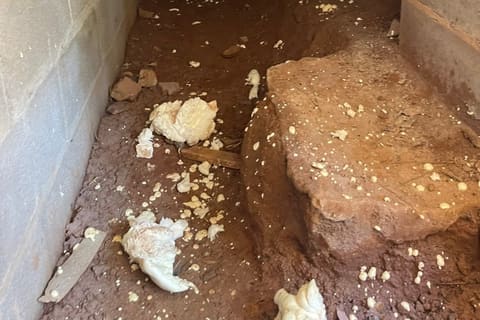
Because humid outside air is getting into a cool crawl space and condensing on your floor joists. Atlanta dew points sit in the low 70s from May into September, and the framing under an air-conditioned house runs cooler than that, so water forms on the wood the way it beads on a glass of tea in August. Mold is the symptom. Clean the wood without changing the water and the air, and you've bought about one season.
What affects how bad it gets and what the fix takes
| Driver | What it looks like under an Atlanta house | Effect on the job |
|---|---|---|
| Moisture source | Humid air only, versus standing water after a storm | Air-only is the smaller job. Standing water means drainage before anything else. |
| Grading and downspouts | Water dumping at a foundation corner, ground sloping back toward the house | Cheapest thing on this list, and skipping it undoes everything above it |
| Ground cover | Bare red clay, or plastic somebody laid loose years ago and never sealed | Full encapsulation rather than a patch |
| Foundation vents | Open vents in July, feeding 74-degree dew point air into a 68-degree space | Vents get closed and sealed as part of the scope |
| Groundwater | Seepage at the footing, wet clay along the uphill wall | Adds an interior French drain and a sump |
| Wood condition | Surface growth on joists, versus soft ends where they sit on the wall | Surface growth cleans up. Rot means framing repair, a different scope and schedule. |
| Insulation | Fiberglass batts sagging out of the bays or already on the ground | Removal and disposal add labor and a dumpster |
| Crawl height and access | 18 inches of clearance and one small door, versus a 4-foot crawl | Tight crawls take longer for the same square footage |
| HVAC down there | Sweating flex duct, a condensate line that stopped draining | Duct and condensate work, often before we seal anything |
What that fuzz on your joists actually is
I'm Donny. I crawl under Atlanta houses for a living, and most of what homeowners text me photos of is surface growth on the subfloor and the underside of the joists. White and cottony, or gray-green and speckled. It's living on the wood because the wood is wet, not because your house is dirty.
The number I care about is wood moisture content. Dry framing reads in the low teens. Around 16 percent it gets interesting. Past 20 percent, growth is a question of when. I take pin meter readings in several spots before I say a word about remediation, because the readings tell me whether I'm looking at an active moisture problem, an old stain from a leak somebody already fixed, or wood that has gone soft. If a screwdriver sinks into a joist end, we're past mold and into rot, and the conversation changes.
Why Atlanta crawl spaces in particular
Our red clay drains slowly. A dirt crawl floor stays damp for days after a storm, and damp ground gives off moisture into the space around the clock, whether or not anyone is home.
Then there are the vents. Houses built here from the 1940s into the 1980s have foundation vents, built on the idea that outside air dries a crawl space out. In a Georgia July it does the reverse. That air walks in carrying more water than the cool wood can hold onto, and it unloads the difference on your joists and your ductwork.
The rest is usually water we can see coming. Downspouts emptying at the corner of the foundation. A yard regraded toward the house when somebody put in a patio. A crawl door at the low side of the lot in Kirkwood or Grant Park, where the whole street tilts. In older Decatur and Chamblee ranches, it's often a condensate line that quit draining two summers ago and nobody noticed, because who looks.
The smell is the tell
Air moves up through a house. Whatever the crawl space smells like, the first floor eventually smells like too, faintly, and usually worst in a back bedroom or a closet over the wettest corner. Homeowners describe it as wet basement, or old books. If allergy symptoms get worse at home and better on vacation, that's worth paying attention to. I'm a contractor and not a doctor, so I won't tell you what a given mold does to your lungs, but I can tell you where the air you're breathing came from.
Fixing it in the order that holds
- Stop the bulk water. Extend the downspouts, correct the grade against the house, and where groundwater is coming through at the footing, run an interior French drain around the perimeter to a sump. Everything after this is decoration if water still runs in.
- Clean the wood. HEPA vacuum, treat the framing, and pull out fiberglass batts that are wet or hanging. Wet fiberglass is a sponge stapled to your floor. That's surface cleaning, not certified remediation — we are not a certified mold remediation company. If what's under your house is a heavy or health-relevant infestation, I'll tell you that straight and point you to a licensed remediation specialist for that part. I'd rather refer it out than overpromise.
- Seal the space. A heavy liner across the ground and up the walls, seams taped, vents and the crawl door sealed. Loose 6-mil plastic thrown over the dirt is the version people call us to redo: it tears the first time somebody crawls on it, it never goes up the walls, and it hides the water instead of stopping it. Tearing one out and doing it right costs more than doing it right once.
- Control the air. A dehumidifier sized to the space and hard-drained, not sitting on a bucket somebody has to remember to empty. This is the part that keeps you from repeating this whole conversation next July.
Skip step one and you get a beautiful white crawl space with water under the liner. Skip step four and you get a sealed space with nothing removing moisture from it. Both happen, and I've replaced both.
What a mold test tells you, and what it doesn't
A lab will name the species. Almost none of that changes the repair. Whatever is growing is growing because the wood is wet, and it quits when the wood dries. Get a test if you want one for your own records. Just don't let anyone build a remediation plan off a lab report instead of off moisture readings and a walk around your foundation.
When it's gone past mold
If it stayed wet for years, the damage isn't cosmetic anymore. Bouncy spots in the hallway. Doors that stopped latching. A joist end that gave up where it met the foundation wall. That work happens on the same trip: crack injection for foundation wall cracks, carbon-fiber straps where a wall is bowing, and new drop girders with interior steel columns to bring a sagging floor back to level and hold it there. It's all listed on our crawl space services page.
Termites and the things living down there
Wet framing attracts more than mold. I regularly find termite damage in the same joists and rim board, plus the gaps where rats or possums have been coming and going. We repair the damaged wood and seal the entry points. We don't treat for insects and we're not a pest control company, so if there's an active colony, your treatment company handles that side and we schedule the repair around them.
What it costs
The spread is genuinely wide, and it moves with the drivers in the table above. A dry crawl that needs cleaning and a liner is a different animal from one with standing water, failed drainage, and two rotted girders. What I'll commit to is this: you get the number in writing after we've been under the house, with the moisture readings and photos attached. No "call for a quote" runaround, and no price invented over the phone before anyone has seen your dirt.
If you're reading this in August
Late summer is when the phone rings about smell, because that's when the dew point has been sitting on your joists for three straight months. It's also a good time to get the water work and the encapsulation on the calendar for fall, while the ground is still workable and before the schedule fills up.
Send photos and tell us which room smells. We'll tell you whether it's a moisture problem or a framing problem before anybody quotes you anything. Start at crawl space services.