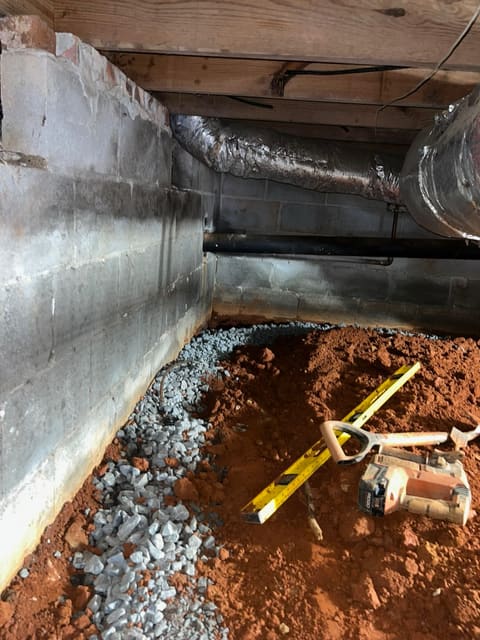
Atlanta's red clay gets blamed for every foundation problem in the metro, but the real mechanism isn't the dramatic "swelling and shrinking" most homeowners picture. Our clay's defining trait is that it drains slowly and holds water — so after a storm it stays saturated for days, pushing moisture into your crawl space and softening the soil under your footings.
We've spent a lot of time under Atlanta-area homes, and the red clay is the common thread on nearly every wet-crawl-space and settling-floor call. Here's what it's actually doing down there, and why the fix is about water, not dirt.
What makes Georgia red clay different
The Atlanta metro sits on the Piedmont, and the signature soil here is the Cecil series — the deep red, iron-rich clay you see every time someone digs a footing or a utility trench. It's the most extensive soil in the Southern Piedmont, and it has one trait that matters more than any other for your house: it's dense and it drains slowly.
Piedmont clay soils take on water far slower than the sandy soils of the coastal plain, and once it's in, it moves sideways along the clay rather than soaking straight down. (U.S. Geological Survey — soils of the Piedmont and Coastal Plain) Translation: rain doesn't disappear into our ground. It pools, it lingers, and it looks for the lowest path — which is often the soil under your house.
Does red clay really "shrink and swell"?
A little — but this is where most internet advice gets Atlanta wrong. The expansive clays that crack foundations in Texas or Denver are high shrink-swell soils that heave several inches with the seasons. Our Cecil-series clay is rated low shrink-swell in the USDA's official soil descriptions. It moves with moisture, but it's not lifting your house up and dropping it.
So if it's not heaving, why does red clay cause so much foundation and floor trouble here? Because the damage is done by water, not movement:
- Saturated clay holds moisture against your foundation walls and footings for days.
- That constant moisture erodes and softens the soil that's actually supporting the footing.
- And the same dampness wicks up into the crawl space, where it rots joists, ruins insulation, and feeds mold.
The soil isn't pushing your house around. It's holding water exactly where water does the most damage.
How red clay shows up in your crawl space
If your house sits in a low spot, at the bottom of a slope, or just has poor drainage, the clay turns your crawl space into a catch basin. After every real rain you get standing water or saturated ground, and because the clay won't drain it, that water sits. (This is the same story we lay out in why your crawl space takes on water after every rain.)
Constant ground moisture under the house is the leading cause of the problems we get called for: musty air pushed up into the living space, sagging and bouncy floors from rotted framing, mold on the joists, and pests that come looking for the damp. The clay doesn't have to flood the space to do this — it just has to keep it humid.
How it works on your foundation
Footings need firm, consistent soil under them. When red clay around and beneath a footing stays saturated for long stretches, two things happen: the soil loses some of its bearing strength, and water moving laterally along the clay can carry fine soil away from under the footing over time. That's the slow erosion-and-settlement pattern we see far more often than dramatic heave.
It shows up the way settlement always does — doors that start sticking, diagonal cracks above door and window frames, floors that slope toward one corner. If you're seeing those, the real culprit is usually water working on the soil, which is why a lasting foundation repair in Atlanta almost always has to fix the drainage too, not just the structure.
To be straight about scope: we stabilize and reinforce from below — crack injection, carbon-fiber straps on bowing walls, and engineered steel support to carry and re-level sagging floors. We don't push piers or underpin footings; if that's genuinely what a home needs, we'll tell you and point you to the right crew.
What actually fixes a red-clay moisture problem
You can't change the soil, so you change where the water goes. The order matters:
- Stop the water at the source. Regrade so the ground slopes away from the house, and extend downspouts so roof water lands well clear of the foundation. The EPA recommends directing downspouts away from the foundation for exactly this reason. (U.S. EPA — Soak Up the Rain: Downspouts)
- Give trapped water a way out. Interior drainage and a sump pump carry off whatever still reaches the crawl space instead of letting the clay hold it there. This is the heart of crawl space waterproofing.
- Repair what the moisture already damaged — rotted joists, failed supports, ruined insulation. That's crawl space repair, not something to seal over.
- Seal the dry space. Once the water's handled, encapsulation wraps the crawl space in a vapor barrier and keeps the clay's ground moisture out for good. (Pricing and what moves it is on our encapsulation cost page.)
Skip step one and you're managing a problem forever. Handle the water in order and the red clay stops being a threat to your house.
Get the actual cause diagnosed
Every lot drains differently, so the only way to know what your red clay is doing is to get under the house and trace it. We'll find where the water's coming from, lay out the fix in order, and put the scope and price in writing before any work starts. Book a free crawl space inspection and we'll tell you straight what your home needs.