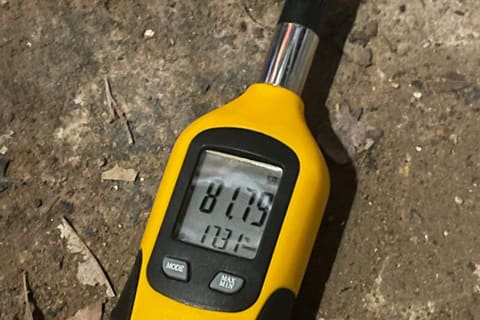
Some dampness in an Atlanta crawl space in winter is common, but that doesn't make it harmless. Our winters are cool and rainy, and the red clay under your house can stay soaked for weeks, pushing water through block walls and into low spots under thin plastic. If you see standing water or wood that feels damp, it won't dry out before spring, and spring is when Atlanta crawl spaces get the most water.
If you'd rather have someone go look, that's our whole job. Our crawl space services cover everything from drainage to full encapsulation.
What affects how bad winter crawl space moisture gets
| Factor | Points to a smaller fix | Points to a bigger job |
|---|---|---|
| Where the water comes from | Damp air, no puddles | Water seeping through the block walls or up at the footing |
| Gutters and grading | Downspouts run well away, yard slopes away from the house | Downspouts empty at the corners, yard slopes toward the foundation |
| Vapor barrier | Heavy liner sealed to the walls | Thin plastic laid loose, torn, or just bare dirt |
| Insulation | Floor insulation dry and in place | Fiberglass batts soaked, sagging, or lying on the ground |
| Ductwork | Sealed ducts, air handler not in the crawl | Leaky return duct pulling crawl space air into the house |
| How long it's been going on | One wet winter | Years of it, with soft joists or a floor that's started to sag |
Most houses I crawl have two or three of these going on at once. Which ones you have decides what the fix looks like and what it costs.
In winter, the water comes from below
In July, crawl space moisture mostly rides in through the vents as hot, sticky air that condenses on cooler wood. Winter works the other way. January air is cold and doesn't carry much water, so the vents aren't the main problem. The water is coming up out of the ground and in through the foundation walls.
Our clay is why. It drains slowly, and with the sun low and evaporation close to nothing, a soaking rain on Tuesday can still be pressing water against your foundation the next weekend. Think of a 1950s block-wall ranch in Tucker or Chamblee with downspouts that dump right at the corners. Every winter storm sends a roof's worth of water straight down the outside of that wall. Most of the older block foundations I see around here have nothing behind them to carry that water away.
What I look for when I crawl a house in winter
Winter is a good time to see what a crawl space is really doing, especially a day or two after a hard rain. Here's what I'm checking:
- A dark wet line partway up the block wall, or a white chalky crust on it. Either one means water is moving through the masonry.
- Water sitting on top of the vapor barrier. Thin plastic laid loose over wet clay collects water in the low spots, and the dirt underneath stays muddy all winter.
- Fiberglass batts hanging down between the joists. Fiberglass soaks up moisture, gets heavy and falls. While it's still up there, it holds that water against your subfloor.
- The wood itself. I put a moisture meter on the joists and subfloor and poke anything suspicious with a screwdriver. Soft wood near the sill plate or under a bathroom gets my attention fast.
- Termite damage. Termites go after wet wood. We repair the damage they leave and seal up entry points. Treatment is your pest company's job, and we work alongside them.
Why the house smells musty when the heat comes on
Plenty of homeowners notice the musty smell in December, not July. That's the stack effect. When the heat runs, warm air rises and leaks out the top of the house through attic hatches and recessed lights. The house replaces that air from the bottom, and a good share of it comes up from the crawl space through plumbing and wiring holes in the subfloor.
If your furnace or air handler sits in the crawl space, check the return duct too. A leaky return pulls crawl space air straight into the system and blows it into every room. In a lot of Decatur and Kirkwood bungalows, the ductwork is the first place I look when someone tells me it only smells when the heat is on.
Should the vents be open or closed in winter?
The old advice was to leave the vents open so the crawl space could breathe. In winter, open vents mostly chill your floors and your water lines. Near-freezing air isn't going to dry a wet dirt floor.
Shutting the vents over a wet floor doesn't fix it either, because now the moisture has nowhere to go. Sealing vents should be one step in a plan: handle the water, put down a real liner, then run a crawl space dehumidifier. Done in that order, a sealed crawl space stays drier year round than a vented one.
What fixes winter moisture
Fix the water before you worry about the air. Roughly from least to most involved:
- Gutters and grading. Extend the downspouts well away from the house and make sure the soil slopes away. It's the cheapest fix, and sometimes it's all a house needs.
- Interior French drain and sump pump. When water comes through the walls or up at the footing, a perforated drain along the inside perimeter carries it to a sump pit, and the pump sends it outside.
- Encapsulation. A heavy reinforced liner sealed to the foundation walls with the seams taped, the vents sealed, and a dehumidifier sized for the space.
- Wet insulation removal. Soaked or fallen fiberglass comes out. In an encapsulated crawl space, the walls get insulated instead of the floor.
- Structural repair. If the wood has been wet for years, soft joists and sagging floors get stabilized with drop girders or interior steel columns.
Which of those your house needs is what drives the price. Extending downspouts can be a Saturday project. A French drain, sump and full encapsulation is a real investment. We give you a written number after we've been under the house, along with photos of what we found.
The plastic-only jobs we end up pulling out
Some of our encapsulation jobs start with rolling up somebody else's plastic. The cheap version is thin sheeting thrown over the dirt, with no seal at the walls and nothing done about drainage. It looks fine in October. After one wet winter there's a pond on top of the plastic and mold growing under it, and the homeowner pays to tear it out before the real fix can go in.
Why winter is the time to deal with it
April and May are when Atlanta gets hammered with rain, and that's when every crawl space company's phone rings. If you find the problem in December or January, there's time to get the drainage sorted before then.
Want to check it yourself first? Go down a day after a hard rain with a good flashlight and look at the walls and the plastic. If you see water, take a picture and send it to us. Or look over our crawl space services and we'll come take a look.