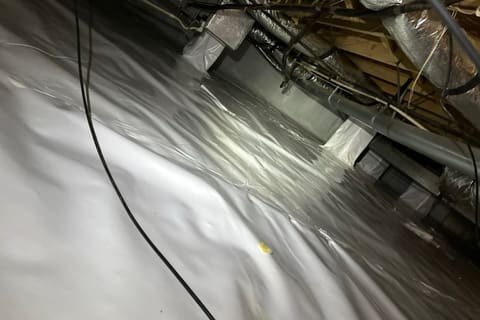
Crawl space repair is the work of fixing what's failing under your house: standing water, sagging or bouncy floors, wood rot, and the moisture that drives all of it. For most Atlanta homes that means some mix of drainage, a vapor barrier or full encapsulation, and structural work like crack injection, carbon-fiber straps, or steel support columns where the framing has dropped. What you actually need depends on what's wrong down there, which is why the first step is somebody crawling under the house and looking, not a number over the phone.
What affects a crawl space repair
No two crawl spaces are the same, so the scope, timeline, and cost swing with what's actually happening under the floor. Here's what we're reading when we get under there.
| What we look at | Why it matters | Pushes the job bigger when |
|---|---|---|
| Where the water comes from | A grading problem at the surface is a different fix than a high water table | Water is coming up through the soil, not just running in after a storm |
| Humidity in the space | Damp air rots wood and feeds mold long after the puddles dry | The space stays muggy all summer and the smell reaches your living room |
| Floor movement | Bouncy or sloping floors point to support that has given up | A main girder has sagged or the supports under it have settled |
| Condition of the wood | Joists and sills have to be sound before anything gets stabilized | Rot or fungal growth means framing gets replaced, not just braced |
| Foundation cracks | A hairline crack and an active, moving crack are not the same job | Cracks are wide, wet, or still moving and need injection or carbon-fiber |
| Size and access | Square footage and clearance set how long the crew is under there | The space is large, low, or packed with old debris and failed plastic |
| Pests and damage | Chewed insulation and open gaps invite the next animal in | Termites or wildlife have damaged framing and left entry points to seal |
What we find under Atlanta houses
Crawl under enough mid-century ranches around Decatur, Kirkwood, and Avondale Estates and you start to see the same story. Red clay that holds water, swells when it's wet, and shrinks hard in a dry August. A vapor barrier that's either missing or torn. A girder that's dropped a half-inch and taken the floor above it along for the ride. By late June the humidity adds its own chapter: condensation on the ductwork, a musty smell that climbs the stairs, and the slow rot that comes with air that never dries out.
None of that fixes itself. The damp gets worse, the wood gets softer, and the bill gets bigger the longer it sits.
What happens during the inspection
A proper inspection means crawling the whole footprint, not shining a flashlight from the access door. We check the girders and joists for rot and sag, take moisture readings in the wood, look at the foundation walls for cracks or bowing, and photograph everything so you can see what we saw without going under there yourself. You should come out of an inspection knowing exactly which pieces of your house are the problem. If a contractor quotes your crawl space from the driveway, get a second opinion.
What crawl space repair covers
Most crawl space repair falls into three kinds of work, and a real job usually mixes them.
Getting the water out comes first. If water stands after a storm, an interior French drain and a sump pump give it somewhere to go instead of sitting on the dirt. Outside the house, that can also mean regrading and fixing gutters so runoff stops pouring against the foundation in the first place.
Then you control the moisture. A vapor barrier seals the ground so soil moisture stops evaporating up into your floor system. Full encapsulation goes further: it seals the walls too, and on a damp Atlanta lot it often pairs with a dehumidifier to hold the humidity down through July and August.
The structural side is where the house gets put back. Crack injection seals foundation cracks to full depth instead of smearing something over the surface. Carbon-fiber straps hold block walls that have started to bow, anchored so the wall can't keep moving. Drop girders and floor stabilization take the bounce out of a floor, and where the original supports have settled, we lift and level the framing on interior steel columns set on proper footings. That lifting goes gradually, sometimes across more than one visit, so the house adjusts without cracking the drywall upstairs.
We also handle the damage pests leave behind. If termites have eaten into a sill or an animal has torn through insulation and ductwork, we rebuild the framing and seal the entry points so nothing else gets in. We don't treat for bugs ourselves. We fix what they damaged, close the gaps, and coordinate with whoever handles your treatment.
The cheap fix we get called to redo
The lowest-budget version of this is a sheet of plastic laid over the dirt and called a day. It looks fine for a year. Then the seams pull apart, water finds its way under it, and the same musty smell comes back. A lot of our jobs are tearing out a thin plastic-only install somebody paid for once and doing the drainage and sealing that should have happened the first time. If you're comparing quotes, ask what happens to the water, not just what gets laid on the ground.
A job from last spring
I crawled under a 1968 ranch off Clairmont in Decatur. The homeowner had two quotes telling her she needed her whole floor system replaced. What she actually had was one rotted drop girder and a downspout dumping straight against the foundation a few feet away. We fixed the downspout, replaced the one girder, set steel columns under the low spot, and sealed the ground. Her floor stopped bouncing, and she paid for the job she had, not the one a sales script wanted to sell her.
That's the whole reason I'm still the one crawling under these houses. You can't diagnose a crawl space from a clipboard in the driveway.
What it costs, and why we won't guess over the phone
We won't put a price on your crawl space before we've been under it. Two houses on the same street in Decatur can need completely different work: one wants a vapor barrier and a little drainage, the next has a rotted girder and standing water. The honest range on "crawl space repair" is wide enough to be useless, because a single crack injection and a full floor rebuild both carry that name.
What we can tell you is how the number gets built: the type of repair, how far the damage runs, whether the water source still needs fixing, and how tight the access is. After an inspection you should get a written scope with photos of your actual crawl space, line items you can question, and a number tied to each one, signed off by our owners. No upsell math, no mystery line items. A quote that skipped the crawl is a guess with your name on it.
When to call someone
Trust your nose and your floors. The common signals around here:
- Floors that bounce, sag, or slope, or gaps opening at the baseboards
- Interior doors and windows that stick or stop latching when the seasons turn wet
- A musty, earthy smell that gets stronger as the summer humidity climbs
- Water or damp soil under the house after a hard rain
- Mold on the joists, or a white crust (efflorescence) on the block walls
- Clammy air upstairs and a cooling bill that keeps climbing
- Insulation falling down, or signs an animal has been living down there
By late June, the humidity does most of the talking. If the upstairs of your house smells like the crawl space, the air down there is moving up into your living space, and that's worth a look before it turns into rot. Crawl space problems are cheapest the year you catch them.
We're a small, owner-run Atlanta crew, not a franchise call center, and we've crawled under enough houses around Druid Hills, Kirkwood, and East Point to tell you straight what yours needs. For more plain-English breakdowns of what's happening under Atlanta homes, read the rest of our blog.