Basement Leak Repair
Why Does My Basement Leak When It Rains — and What Does It Cost to Fix?
If water shows up in your basement after a heavy rain, it's almost never random — it's pressure. Our red clay soil holds water against the foundation and pushes it through any crack, joint, or porous spot it can find. The fix ranges from sealing a single crack to managing the water with an interior drainage system, up to excavating and waterproofing the wall from the outside. Interior drainage with a sump starts at about $3,000, and exterior work is the bigger job. Here's how to tell what yours needs.
The honest version
Why does my basement leak when it rains?
A dry basement that floods after a storm is a pressure story. When it rains, the clay around your foundation soaks up water and swells, and all that saturated soil presses in against the walls and up under the floor. That's hydrostatic pressure, and it forces water through wherever the concrete is weakest. The usual entry points:
| Where it comes in | What's actually happening |
|---|---|
| Wall cracks | Pressure opens and widens cracks, and water follows them straight in. |
| The floor-wall joint (cove) | The seam where the wall meets the floor is the lowest, weakest point — water pushes up through it. |
| Porous block or poured walls | Concrete wicks water. Under enough pressure it weeps right through the wall face. |
| Failed or missing drainage | If the original footing drain is clogged or was never there, water has nowhere to go but in. |
| Grading and downspouts | Soil that slopes toward the house, or downspouts dumping at the foundation, feed the problem from above. |
Knowing the entry point is half the repair. The other half is deciding whether you manage the water once it's at the wall, or stop it before it gets there.
What does basement leak repair cost in Atlanta?
There's no single number, because "a leak" can be one crack or a whole wall under pressure. Here's the honest range by what you're actually dealing with:
| The fix | What it involves | Typical cost |
|---|---|---|
| Crack injection | Polyurethane or epoxy that seals a leaking crack full-depth | Around $750 per crack |
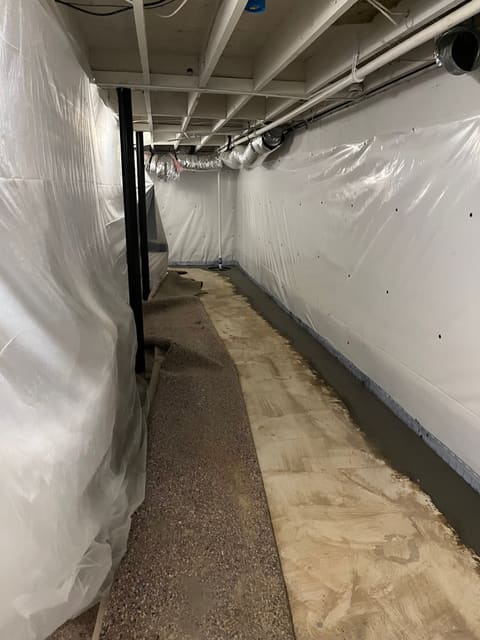
| Interior drainage + sump | A perimeter drain at the floor-wall joint that collects water and routes it to a sump pump | from $3,000 |
| Exterior waterproofing | Excavating down to the footing, sealing the wall from outside, and correcting the drainage — the bigger, more involved job | varies by depth & access |
We don't run a calculator here on purpose — a real figure comes from seeing the water, not guessing at it. The free inspection is where we find the entry point, tell you whether it's a crack, a drainage job, or exterior work, and put the price in writing. On bigger projects we offer interest-free financing, and every repair carries a 2-year warranty.
Interior drainage or exterior waterproofing — which do you need?
This is the question that decides the cost, so here's the straight version. Interior drainage manages water after it reaches the wall: a channel at the floor-wall joint catches it and a sump sends it out. It's less disruptive, doesn't tear up your yard, and for most Atlanta basements it's the right call — that's the work that starts around $3,000.
Exterior waterproofing stops the water at the outside face of the wall before it ever gets in, by excavating down to the footing, sealing the wall, and fixing the drainage out there. It's the bigger job — more excavation, more labor, more to put back when it's done — and it costs more accordingly. It's the answer when there's structural cracking, a wall that's taking on serious water, or a finished basement worth protecting from the outside in. We'll tell you honestly which one your situation calls for, instead of selling you the most expensive version by default.
Why Atlanta basements leak more than the average
Red clay is the reason. It's expansive soil — it swells when it's wet and holds that water against your foundation for days, long after the storm has passed. Sandy soil drains and relieves the pressure; clay traps it. That's why a basement that's bone dry for months can suddenly take on water after one hard rain, and why national waterproofing advice underestimates what an Atlanta home is dealing with.
Add the older housing stock around Decatur, Druid Hills, and East Atlanta — homes built before modern drainage standards, with footing drains that have long since clogged or collapsed — and you have the local reason the water keeps finding its way in.
Why a quick patch doesn't hold
The hardware-store fix is a coat of waterproof paint or a smear of hydraulic cement over the wet spot. It feels like a repair, and it lasts until the next real storm. The problem is that paint and patch don't touch the pressure driving the water — they just put a thin barrier in front of it, and pressure always wins. Worse, sealing one spot often pushes the water to the next weakest point, so the leak "moves" and you're chasing it around the basement.
A repair that holds addresses the water itself — sealing the crack full-depth, or giving the water a managed path out with drainage, or stopping it at the wall from outside. You pay once for the fix that matches the actual problem instead of three times for patches that don't.
How It Works
Four steps. No confusing jargon.
We keep the process simple and transparent so you know exactly what to expect before anyone starts work.
-
Inspection
We evaluate the crawlspace or basement and document what we find with photos and moisture readings.
-
Assessment
We review moisture levels, drainage, and structural integrity to understand the full picture.
-
Clear Plan
You receive a practical proposal tailored to your property. No jargon, no pressure, no surprises.
-
Repair
Our team performs the work and walks you through the result so you see exactly what was done and why.
Homeowner Proof
What Atlanta homeowners say.
Extremely happy and grateful for the service I received. They came out the same day I called for an estimate and provided it right away. I loved the entire experience, and would definitely recommend them and use them again.
Frequently Asked
Common questions
Why does water come into my basement only after heavy rain?
How much does it cost to fix a leaking basement in Atlanta?
Is interior or exterior waterproofing better?
Can I just use waterproof paint or hydraulic cement?
Will my homeowners insurance cover a leaking basement?
Do you offer financing for basement waterproofing?
Don’t Wait Until It’s Major
Get a clear plan for the space below your home.
Schedule a crawlspace or basement evaluation and understand what needs attention — no pressure, no obligation.
Free & No Obligation
Schedule Your Inspection
Tell us what’s happening under the house. We’ll follow up within one business day.